


 Home
Homecurrent location: Home> Central News
Central News
Research Achievement | PhD Student Sihang Rao from Professor Hongmei Yi’s Team Publishes First-Author Paper in China Economic Review, Revealing the Impact of Higher Vocational Education on Early Earnings and Career Development of Secondary Vocational Students in China
Release date:2026/04/15 Source: CCAP
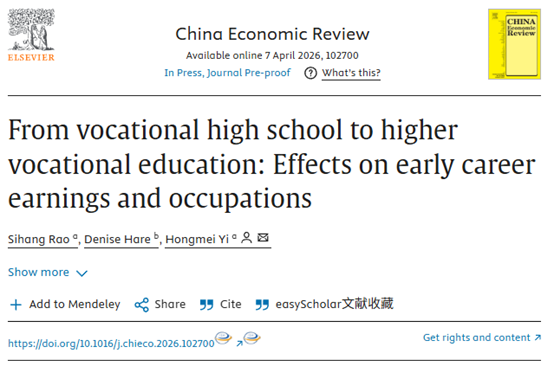
Recently, Sihang Rao, a 2020 PhD student from the team of Professor Hongmei Yi at the School of Advanced Agricultural Sciences, Peking University, published a research paper titled “From Vocational High School to Higher Vocational Education: Effects on Early Career Earnings and Occupations” as the first author in the international journal China Economic Review. Professor Hongmei Yi is the corresponding author, and the co-authors include Denise Hare, Professor of Economics at Reed College, USA.
Against the backdrop of the continuous expansion of higher education worldwide, broadening pathways for vocational education students to pursue further studies has become an important direction of reform in many countries, with China being a typical example. In 2010, only 9.2% of secondary vocational school graduates in China continued to higher education; by 2020, this proportion had risen to about 65%, with nearly 90% entering higher vocational colleges. From 2018 to 2022, the enrollment scale of higher vocational education nationwide increased from 3.7 million to 5.4 million, representing nearly a 50% growth. In this context, whether and to what extent pursuing higher vocational education improves the labor market outcomes of secondary vocational students has become a key issue of concern, yet empirical evidence remains limited.
Based on longitudinal survey data collected since 2013 by Professor Yi Hongmei’s team, covering 7,153 students from 117 secondary vocational schools in Henan Province, this study evaluates the impact of completing higher vocational education on early earnings and career development. The study compares the labor market outcomes of students from the same cohort who followed two different pathways: entering the labor market directly after graduating from secondary vocational school, or continuing into a three-year higher vocational program before entering employment. Outcomes examined include wages and occupational types in their first full-time job, as well as in their full-time job at the time of the 2021 follow-up survey.
The results show that higher vocational education significantly increases the starting wages of secondary vocational graduates when they first enter the labor market. However, five years after secondary vocational graduation, or two years after completing higher vocational education, the wage differences between the two groups are no longer statistically significant. Further decomposition of wage premiums into within-occupation and between-occupation components reveals that this change is mainly driven by variations in within-occupation wage premiums. The initial wage advantage associated with higher vocational education primarily stems from within-occupation premiums, whereas students who enter the labor market directly after secondary vocational education accumulate work experience earlier within the same occupation, leading to wage growth that gradually narrows the gap between the two groups.
More importantly, higher vocational education significantly alters the career trajectories of secondary vocational students. Compared with those who enter the workforce directly, graduates of higher vocational education are more likely to enter and remain in non-routine cognitive occupations with higher social status, while direct entrants find it more difficult to access such occupations. Since these occupations typically offer faster wage growth, if inter-occupational wage growth differentials persist, the wage advantages of higher vocational education may re-emerge and further expand over the longer term.
This study is one of the later-stage outcomes of the National Natural Science Foundation of China (Excellent Young Scientists Fund) project “Vocational Education Management and Policy,” led by Professor Hongmei Yi. To further explore the value of the dataset and promote research in China’s vocational education field, scholars interested in related topics are welcome to contact for collaboration (hmyi.ccap@pku.edu.cn). For more details on the project and survey instruments, please visit: http://scholar.pku.edu.cn/hongmei-yi/zhi-ye-jiao-yu-guan-li-yu-zheng-ce-0.
Citation:
Sihang Rao, Denise Hare, and Hongmei Yi. From Vocational High School to Higher Vocational Education: Effects on Early Career Earnings and Occupations. China Economic Review (2026): 102700.
Full text link: https://doi.org/10.1016/j.chieco.2026.102700
CER official WeChat post: https://mp.weixin.qq.com/s/f6U_DpXQDSDq-30TH5RWbw