


 Home
Homecurrent location: Home> Central News
Central News
Feeding 1.4 Billion People and Securing the Future: Peking University Dean Jikun Huang ’s New Book Systematically Addresses Three Defining Challenges of Chinese Agriculture
Release date:2026/06/15 Source:
Against the backdrop of intensifying geopolitical conflicts, increasingly frequent extreme climate events, and volatile international food prices, a fundamental question confronts China—a nation of more than 1.4 billion people: How can it continue to ensure its food security? Under the constraints of ecological conservation and sustainable development, how can agriculture not only feed the population but also improve farmers’ livelihoods?
Recently, National Food Security, Sustainable Agricultural Development, and Common Prosperity for Farmers, a major academic work by Jikun Huang, Boya Chair Professor at Peking University, Changjiang Distinguished Professor appointed by China’s Ministry of Education, and Dean of the School of Advanced Agricultural Sciences at Peking University, was officially published by Zhejiang People’s Publishing House.
The book directly addresses the most critical and challenging “triangle” in China’s agricultural modernization process—food security, agricultural sustainability, and common prosperity—and seeks to provide both a strategic framework and practical solutions for building a strong agricultural nation in the new era.
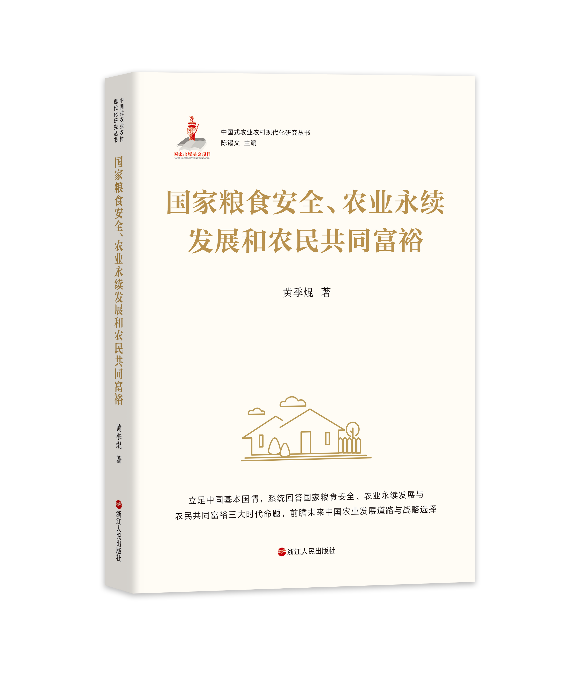
Grounded in China’s unique national and agricultural conditions, the book systematically reviews the historical evolution, structural transformation, major achievements, and current challenges of China’s agricultural development since the beginning of the Reform and Opening-up period. Focusing on the three core objectives of national food security, sustainable agricultural development, and common prosperity for farmers, it develops an integrated analytical framework that links technological progress, institutional innovation, policy support, and investment priorities with agricultural growth, sustainability, and rural income enhancement.
Beginning with the trends in grain and major agricultural commodity production over the past four decades, the book examines a wide range of topics, including the optimization of agricultural production patterns, rural economic transformation and farmer income growth, the drivers of agricultural productivity growth, the evolving concept of national food security, institutional mechanisms for seed industry development, sustainability challenges in agriculture, and the evolution of national strategies and policies. It further explores major issues such as future supply and demand trends for agricultural products, institutional innovations under the “Greater Food Approach,” and the development of new quality productive forces in agriculture tailored to local conditions. The book concludes with a forward-looking vision for food security, sustainability, and common prosperity.
The volume not only summarizes China’s successful experience in achieving sustained growth in grain production, continuous optimization of agricultural structure, and rising rural incomes despite severe constraints on land and water resources, but also identifies a series of deep-rooted challenges, including limited arable land and water resources, environmental pressures, declining comparative advantages in agriculture, slowing growth in farmers’ incomes, and increasing pressure to secure feed supplies—particularly protein feed. In response, it proposes a comprehensive and systematic development strategy.
The book argues that China’s future agricultural development must embrace a systems perspective and strategic thinking. While ensuring the absolute security of staple grain supplies, greater attention should be given to food security in a broader sense, resource conservation, green and low-carbon development, and the coordinated promotion of farmers’ income growth. It advocates continued reliance on four key drivers—technological innovation, institutional innovation, market-oriented reform, and infrastructure development—to accelerate the development of a diversified agricultural system under the Greater Food Approach, foster new quality productive forces in agriculture, and modernize agricultural production methods, industrial systems, and governance structures.
The book also emphasizes the importance of balancing domestic development with international cooperation. China should not only “put its own house in order” but also contribute to global development and food security through openness and collaboration.
Combining strategic vision, theoretical depth, and policy relevance, this work serves both as an important academic contribution for understanding the logic of China’s agricultural development and the future direction of agricultural transformation, and as a valuable reference for policymakers seeking to strengthen agricultural productivity, improve quality and efficiency, and advance the construction of an agricultural powerhouse.
Editor’s Recommendation
This scholarly work is authored by Professor Huang Jikun, one of China’s leading agricultural economists. The book provides a systematic analysis of three major themes: food security, sustainable agricultural development, and sustained income growth for farmers.
The volume consists of thirteen chapters. Chapter One serves as an overview of the entire book, presenting its central arguments. It contends that, given China’s specific national and agricultural conditions, the ideal pathway to addressing the challenges of food security, sustainability, and farmer income growth lies in ensuring the absolute security of staple grains, developing high-value agriculture, promoting green transformation, and pursuing development in cooperation with the international community.
The chapter introduces the concepts of “Getting Our Own House in Order” and “Shared Development.” It argues that China should make every effort to strengthen its own food security, sustainable agricultural development, and common prosperity for farmers, while simultaneously promoting openness, international cooperation, and assistance to partner countries. Such efforts would not only contribute to global development but also create a more favorable environment for China’s own food security and sustainable development.
The remaining twelve chapters elaborate on and substantiate these ideas from three perspectives:
The growth of China’s agricultural production and rural economic transformation over the past forty years, together with their principal driving forces;
The major challenges facing food security, sustainability, and farmer income growth, as well as corresponding policy responses;
Future development trends, long-term visions, and strategic priorities.
The publication of this book is expected to stimulate significant academic discussion and attract widespread attention. It is highly recommended for scholars, policymakers, practitioners, and anyone interested in China’s agricultural development, food security, and rural revitalization.