


 Home
Homecurrent location: Home> Central News
Central News
Malaysian Agriculture and Food Security Delegation Visits PKU School of Advanced Agricultural Sciences
Release date:2026/09/10 Source: CCAP
On September 9, 2026, a delegation from Malaysia’s Ministry of Agriculture and Food Security visited the School of Advanced Agricultural Sciences (SAAS), Peking University, for discussions on agricultural technology, rural transformation, food security, and future cooperation. The delegation brought together representatives from the Malaysian government, parliament, trade and economic organizations, and industry. Members included Luqman bin Ahmad, Deputy Secretary-General of Malaysia’s Ministry of Agriculture and Food Security, and Tan Kar Hing, Member of Parliament for Gopeng and Chairman of the Regional Strategic Research Centre. Wang Qinfang, Ph.D., Chair of the Board of Supervisors of the China Association for the Promotion of International Agricultural Cooperation, and Huang Jie, Ph.D., Executive Vice Dean of the Asian Innovation Research Center of Malaysia, also attended the meeting. The delegation was received by Professor Jikun Huang, Dean of SAAS and Peking University Distinguished Professor of Humanities and Social Sciences; Professor Chengfang Liu, Boya Distinguished Professor and Associate Dean of SAAS; Research Fellow Yue Wang; Assistant Research Fellow Yifeng Zhang; and other faculty members. The meeting was chaired by Professor Liu.
Professor Liu welcomed the delegation and gave an overview of the School’s development, covering its academic disciplines, faculty, talent development, research and innovation, policy advisory work, and international cooperation. She highlighted recent research in agricultural biotechnology, agricultural and development economics, and food security and health. She also introduced several research platforms affiliated with Peking University, including the Institute of Advanced Agricultural Sciences, the China Center for Agricultural Policy, Peking University, and the Institute of New Rural Development, Peking University, and outlined their roles in advancing agricultural innovation and policy research.

Luqman bin Ahmad and Tan Kar Hing thanked the School for its warm welcome and introduced the major responsibilities of Malaysia’s Ministry of Agriculture and Food Security as well as the country’s priorities for agricultural development. They emphasized Malaysia’s strong commitment to food security and sustainable agriculture. Under its National Agrofood Policy 2021–2030, Malaysia is working to accelerate technological innovation in agriculture, improve productivity, and strengthen agricultural value chains. The delegates expressed their hope that the visit would deepen their understanding of China’s experience in agricultural science and technology and policy research, and open up further opportunities for cooperation between China and Malaysia.


Professor Huang Jikun then delivered a presentation on digital and biotechnological innovation and policies for rural transformation. Drawing on studies of agricultural crop-protection drones, digital agricultural markets, rural e-commerce, and online credit, he discussed how digital technologies can improve agricultural productivity, facilitate agricultural trade, and expand access to finance for smallholder farmers. Professor Huang emphasized that the adoption of digital agricultural technologies should respond to the practical needs and capabilities of smallholders. He highlighted the importance of strengthening digital skills training, improving mechanisms for data sharing, and developing complementary support services. Turning to rural transformation, Professor Huang drew on China’s experience and cross-country comparative research to examine the links between rural transformation, income growth, and poverty reduction. He discussed the important roles of institutions, policies, and investment in this process, as well as possible pathways toward a greener transformation of agriculture and rural areas.

During the discussion, participants exchanged views on the application and service models of agricultural drones, the commercialization of research outcomes and intellectual property, and the wider adoption of digital technologies. Drawing on agricultural conditions in Malaysia, members of the delegation raised questions about the operating costs of drones, the conditions needed for effective technology dissemination, and potential risks facing farmers when adopting new technologies. They also expressed interest in combining suitable Chinese agricultural technologies with local service resources in Malaysia to advance agricultural digitalization. The two sides further discussed how agricultural service systems could help reduce barriers to technology adoption and encourage smallholder farmers to make greater use of new technologies.

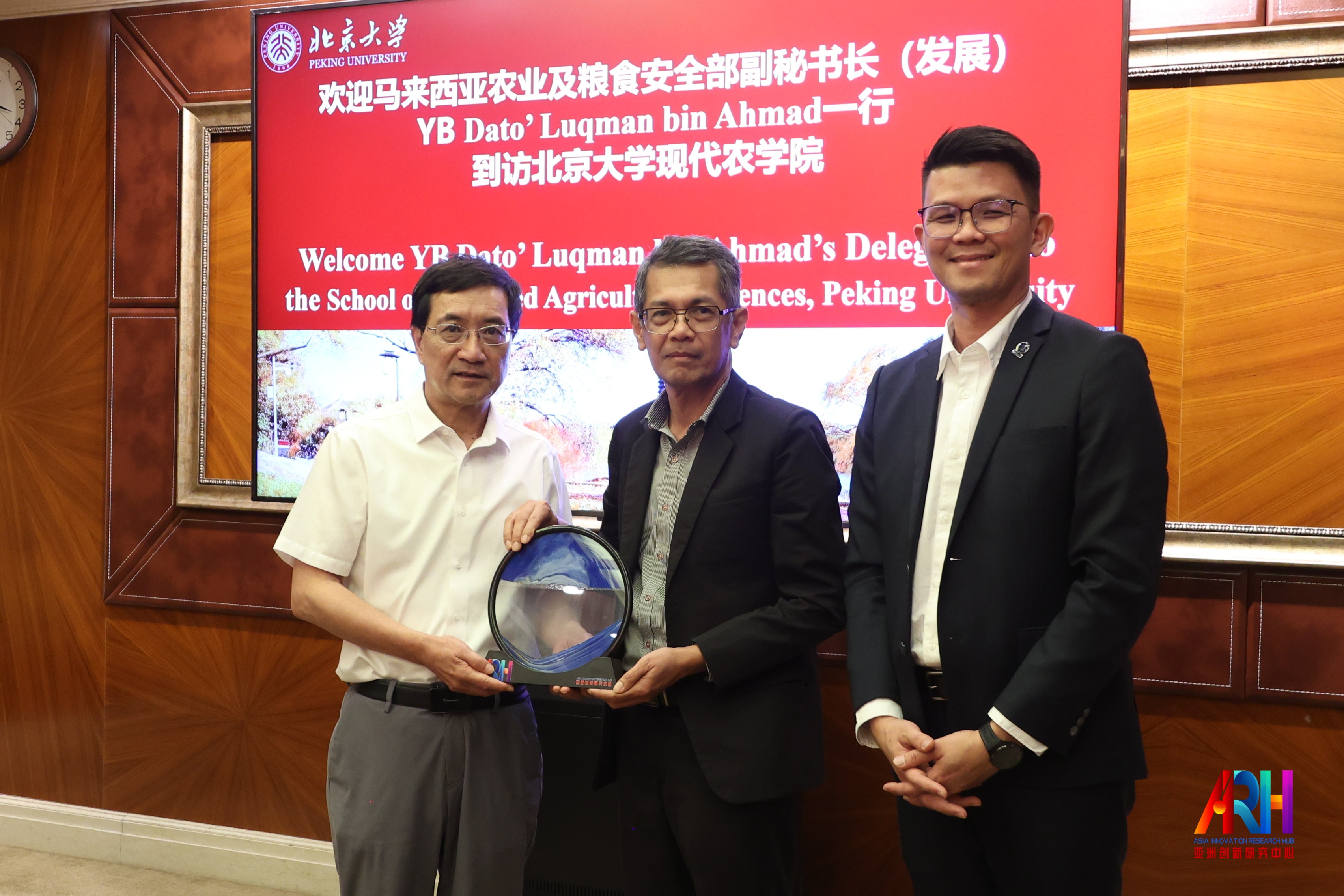
Following the meeting, representatives from both sides exchanged commemorative gifts and took a group photo. The Malaysian delegation later toured the Peking University campus accompanied by Zhi Huayong, learning more about the University’s history, campus environment, and rich cultural heritage.


The visit enhanced mutual understanding of agricultural research capabilities and development needs in China and Malaysia, and created new opportunities for cooperation in agricultural science and technology, policy research, and talent exchange. The School of Advanced Agricultural Sciences will continue to leverage its interdisciplinary strengths, share China’s experience in agricultural and rural development through international exchange, and contribute academic expertise to the sustainable development of agriculture.