


 Home
Homecurrent location: Home> Central News
Central News
China Economic Review | Professor Jikun Huang’s Team Decodes Local Government Promotion and Agricultural Industry Cluster Evolution, Offering New Policy Insights for Agricultural Transformation
Release date:2026/05/06 Source: CCAP
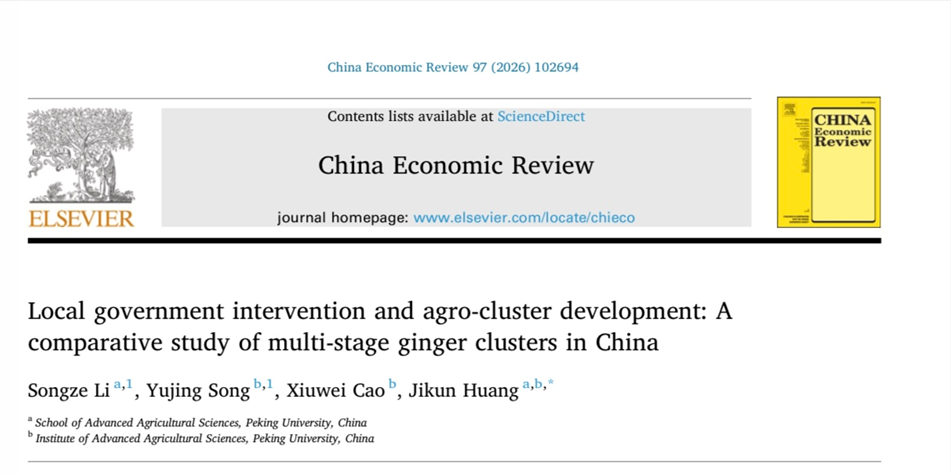
n April 2026, Professor Jikun Huang’s team published a research paper in the journal China Economic Review, titled “Local Government Promotion and Agricultural Industry Cluster Development: A Multi-Stage Comparative Study of Ginger Clusters in China.” The study focuses on China’s ginger industry and employs a combination of multi-case comparisons and long-term panel data analysis to systematically reveal the intrinsic relationship between the timing and combination of local government promotion and the development trajectories of industry clusters.
The research examines four ginger-growing counties—Anqiu, Changyi, Fengrun, and Funing—which had similar initial conditions but distinct development paths. By integrating county-level statistics, local chronicles, remote sensing imagery, and enterprise registration data, the team constructed a panel dataset spanning 1980–2024. Based on this, a multidimensional indicator system was developed to categorize the evolution of agricultural industry clusters into four stages: “initialization,” “rapid growth,” “stable development,” and “transformation.” This framework enabled systematic tracking and comparative analysis of the four counties’ development trajectories.
Local government promotion was classified into three types: production support, market infrastructure construction, and market environment optimization. Through systematic coding of over 40 years of policy documents and comparative analysis of cluster evolution paths, the study finds that while the initiation of industry clusters depends on natural endowments, subsequent growth and transformation are closely linked to the timing, combination, and coordination of local government actions. Specifically, during the initial stage, investments in market infrastructure help reduce smallholders’ sales risks, encouraging the start of commercial production; during rapid growth, production support policies effectively boost output and quality, driving scale expansion; in the stable development stage, market environment optimization policies (e.g., brand building, quality certification) are crucial in guiding clusters toward higher-value-added transformation.
The study also highlights the enduring influence of early-mover advantages. Early entrants Anqiu and Changyi not only established stable market functions but also locked in structural development directions: Anqiu, focusing early on exports and processing, evolved into a high-value, innovation-driven cluster; Changyi, emphasizing market infrastructure, gradually became a domestic ginger distribution hub. In contrast, latecomers Fengrun and Funing, despite later policy investments, struggled to overcome existing market structures, demonstrating significant path dependence and functional lock-in effects.
To validate these qualitative findings, the researchers applied panel regression models. Results show that all three types of promotion are significantly positively correlated with cultivated area share and value chain density, with effects varying by stage: market infrastructure investment is most critical early on, production support is most effective in the mid-stage, and market environment policies continue to play a role later. These results remain robust after adjusting weights and controlling for climatic variables.
This study demonstrates a research paradigm that integrates long-term, multi-case qualitative comparisons with quantitative verification, breaking down the complex evolution of industry clusters into quantifiable and adaptable policy combinations. Policy implications include: local governments should abandon “one-size-fits-all” approaches and implement stage-appropriate policy portfolios—investing in market infrastructure in the initial stage, strengthening production services and technical support during rapid growth, and focusing on brand building and quality certification in the stable development stage. Additionally, late-developing regions should avoid “imitative development” traps and fully leverage their comparative advantages to pursue differentiated growth paths.
Dr. Songze Li, a PhD student at School of Advanced Agriculture Science of Peking University, and Associate Researcher Yujing Song are co-first authors of this paper; research assistant Xiwei Cao contributed to the study; Professor Jikun Huang, Dean of School of Advanced Agriculture Science of Peking University and Director of the Rural Revitalization Strategy Center at the Institute of Modern Agriculture, served as the corresponding author.
Original article link: https://www.sciencedirect.com/science/article/abs/pii/S1043951X26000441